

On sketchbooks, blank pages, digital overwhelm and time capsules.
Sketchbooks series 1.

Sometimes I think we go through seasons of collecting.
We gather up experiences and discoveries, ideas and random bits of inspiration. These things accumulate in our brains like leaf litter; they begin to meld and mulch with all the other things we’ve kept there.
Then there’s times of fruit - when all those ruminating, composting things make their way back up into the things we do, the art we make.
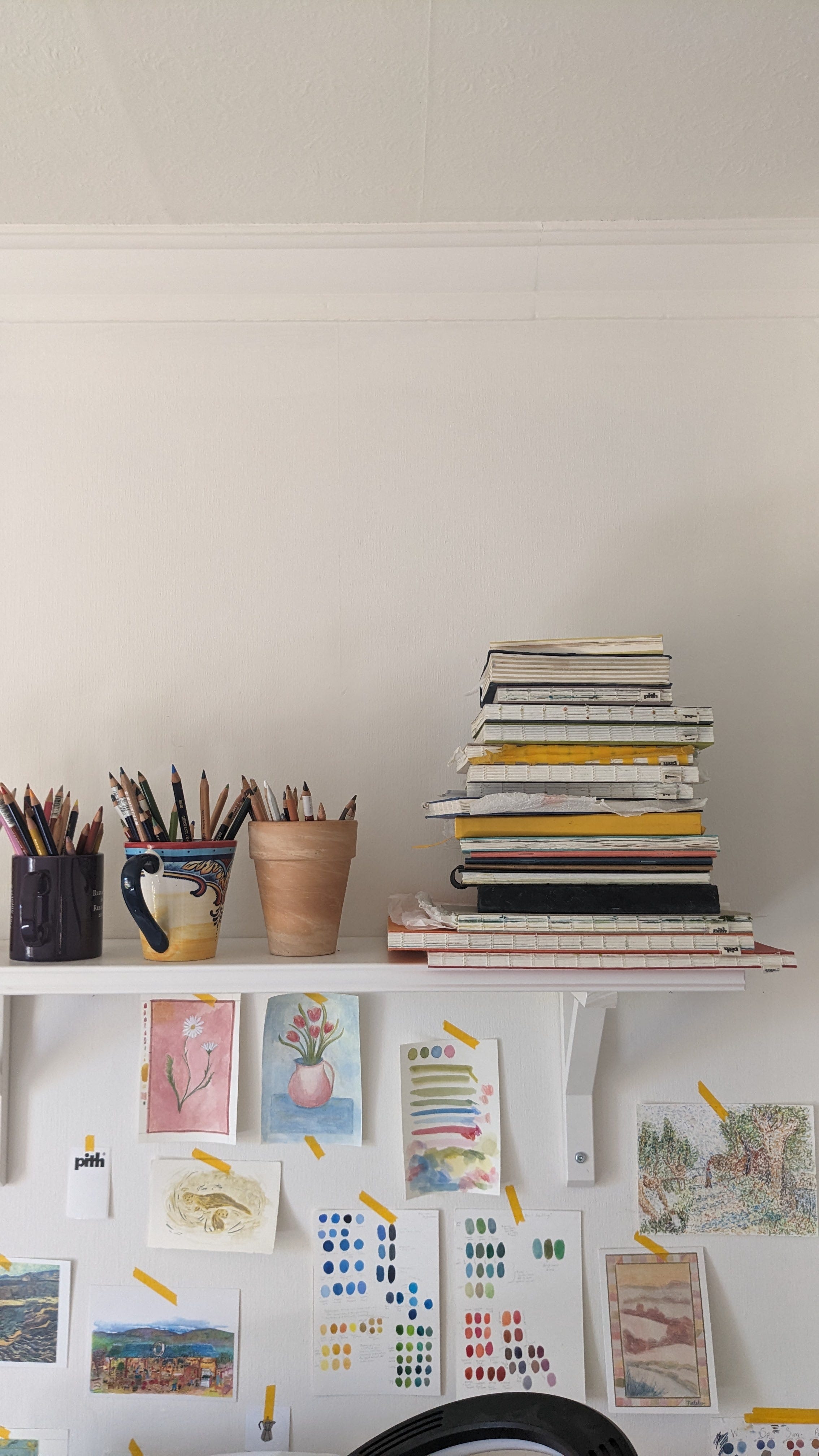
I had the idea of sharing a bit about sketchbooks. I have a fair few of them these days, piled in an architecturally-dodgy stack over my art desk.
They are, almost exclusively, the surface I use to create things. I like that they are the shape of a book; I can open to a clean page and close them up after. I like that I can tear pages out and glue things in. I like that they bear fingerprints, food spills, rain splatters and all the other elements of life. I even like the annoying things, like the smudging page to page; it makes me less precious.


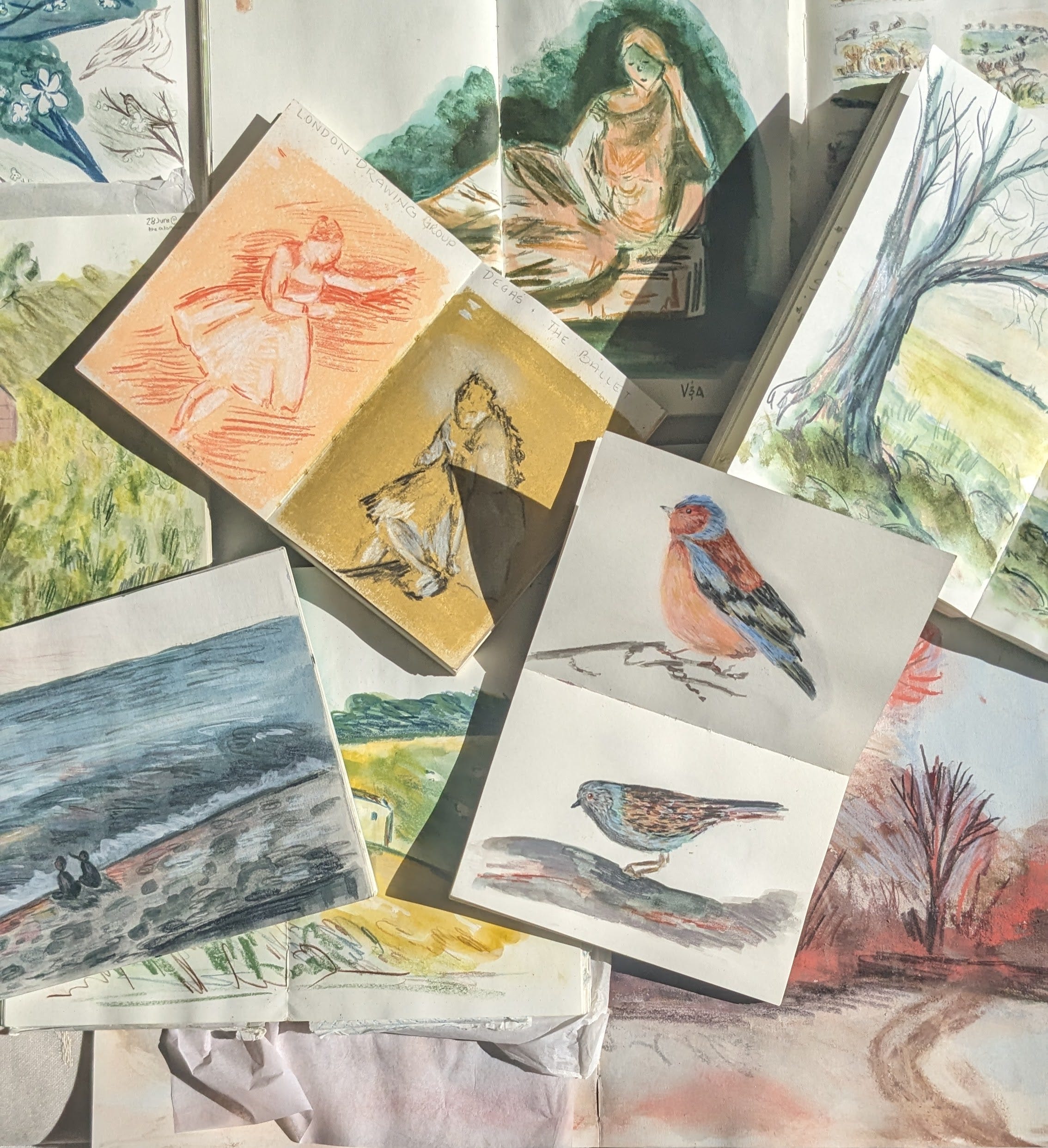
My sketchbook is not really meant to be a metric for artistic skill - I have to remind myself this when I see the bits that went really wonky. Rather, it functions as a companion through a particular season of life. I spent the weekend flipping through and cataloguing each one - June to July 2024, November - January 2025, March to May 2026…
Sketchbooks are a place where some little ideas take root and others don’t. They are compost bins - mostly a lot of rubbish, but they’re also really good for growing.
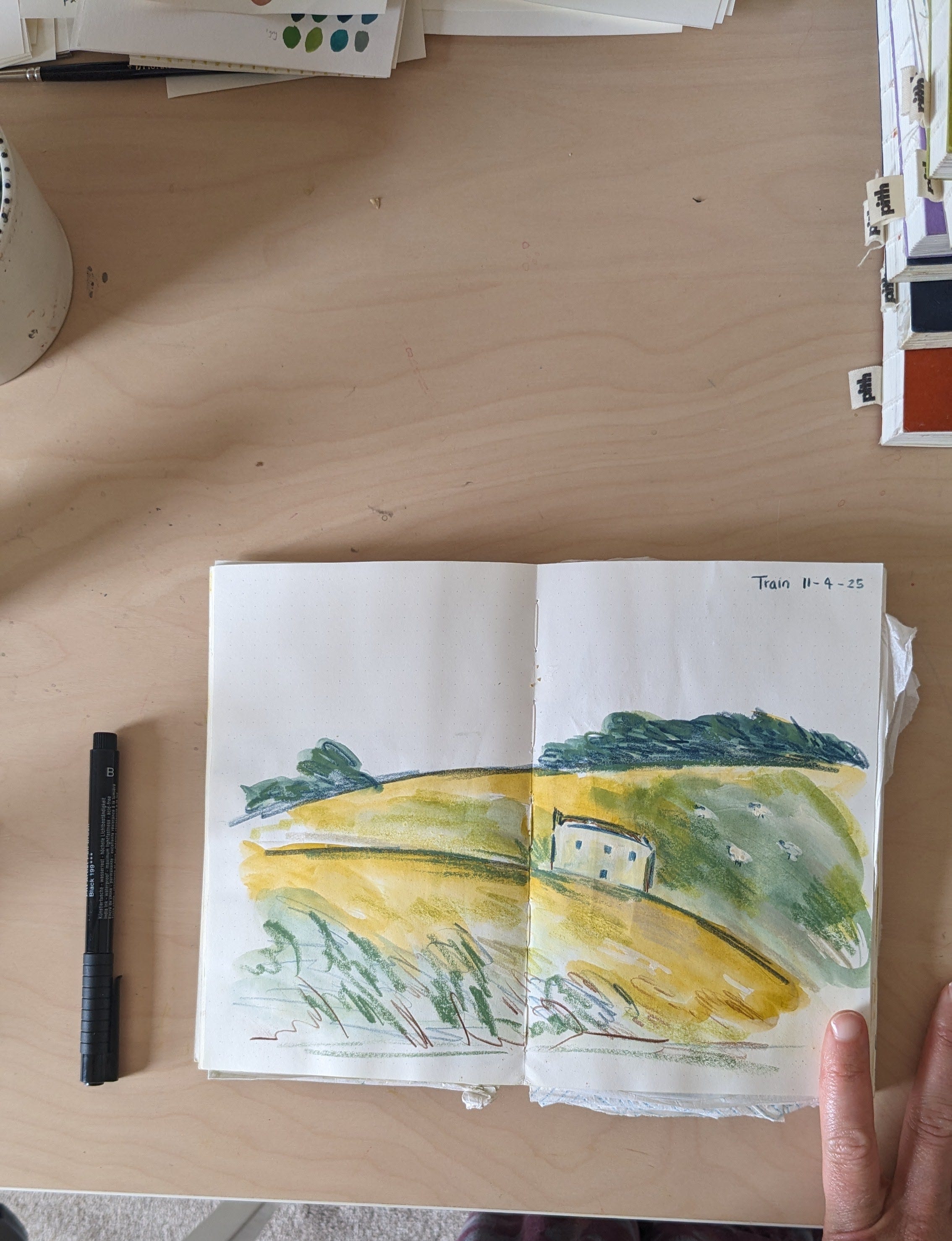
This is part one of a series I’ll be sharing throughout the summer, all about sketchbooks. I’ll be taking you on a bit of a journey through my mind, through microseasons, daily drawing, drawing in nature, drawing about nature, and drawing from life…
Here I offer an introduction to sketchbooks, their brilliance in an age when many of us are looking for something a bit more ‘offline’, and a peek into my own personal sketchbook stack.
The Analog Trend
At the start of 2026, I was inundated with a wave of social media posts all about ‘going analog’. It certainly struck a chord; many of us want to separate ourselves from the relentlessness of our digital apps.
The irony of this isn’t lost on me - I find that when we’re all ‘online’ more than we think we should, we see something of a justification in plugging into things that feel ‘offline’. Instagram’s new keyword function throw content to me all about ‘slow living’, ‘gardening’, and ‘nature walks’. If I see rosy-filtered reels of a sunset, a beautifully arranged vase of garden-cut flowers, does it really count?
I’m particularly aware of my screen use with a seven-month-old, who has already begun to see my phone as something separate and more exciting than the physical media I intentionally give him. We want our child’s life to be screenless as much as possible, but it is a bit challenging when we still use them regularly.
At the start of the year, I was challenged by Allyson at Fox Hollow’s idea to decentralise our phones - the process of creating an ‘analog toolkit’ with all the things usually consolidated on our devices - a camera, watch, calculator, notebook. Keeping these things separate provides us a bit of breathing space and a chance to check the time without giving half an hour inexplicably to Instagram in the process.
I don’t really have a toolkit, but I do keep a sketchbook. And, at least for a few minutes everyday, I engage with paper and pencil.
When it comes to a sketchbook, there is no algorithm, no faceless audience, no concern for hooks and share value. We need not consult the insights for how we fill the blank page before us, and afterwards we can shut the book and put it on the shelf.
A Sediment of Sketchbooks
I’ve been keeping sketchbooks regularly for about three years.
Around the summer of 2023, I set myself the goal of going to the park every day the weather allowed; I’d usually bring a book or sketchbook with me for company. Then in 2024 - a year my husband offhandedly dubbed the ‘year of nature’ - I started sketching more regularly as a way to notice and write about the more minute details of nature I saw. throughout the year.
The more I think about that time in my life - it was right after an insanely tiring series of years, where I completed a PhD and trained to be a teacher with no break in between (*literally* no break, I submitted my thesis during induction and did my viva in the middle of one of my teaching placements) - that was a moment of recovery. I needed to move at a slower pace for a while.
Around then, I started this blog as a place to share with friends and family the things I’d been seeing and drawing.
By nature, I’m a bit of a quitter - I have a yarn stash full of unfinished knitting projects to prove it - but in knowing this about myself, I find it important that there are some things that I keep doing. This blog is one of those things. Sketchbooking is another.


Over my desk is a shelf piled high with sketchbooks. I don’t look at them often - many of them make me cringe - but sometimes I do open them up and feel transported to different moments in time.
Sketchbooks do three important things for me: Firstly, they invite me to spend a few moments of my day ‘unplugged’. Secondly, they encourage me to see, interact, and record the world around me in a more intentional way - I am always in search of subjects. Thirdly, they become time capsules for my forgetful brain, inviting me to look back at all the nice moments I thought worthy of capturing.
I think I’ve realised the magic of sketchbooks comes with commitment. Fill a sketchbook, then another, then another. Stack them one on top of another and create for yourself a sediment, a stratigraphy of sketchbooks - a place where new ideas find good soil.